 Free Transportation
Your Child Lost a Tooth Early—What Happens Next?
Did your child lose a baby tooth early? Learn about space maintainers, permanent tooth development, dental alignment, and when to visit a pediatric dentist.
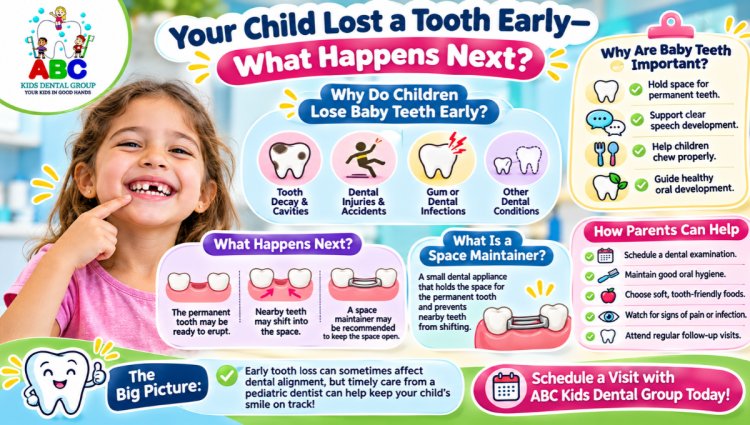
Losing a baby tooth is an exciting milestone in every child's life. However, what happens when your child loses a tooth much earlier than expected? Whether it happens because of an accidental fall, tooth decay, infection, or another dental problem, early tooth loss can leave parents wondering whether it will affect their child's permanent teeth.
Baby teeth may eventually fall out, but they play an important role in your child's oral development. They help children chew comfortably, speak clearly, and maintain the necessary space for permanent teeth to grow properly. Losing one too early can sometimes lead to dental alignment problems if the space is not monitored.
At ABC Kids Dental Group, we believe that educating parents is an important part of keeping children's smiles healthy. Let's understand why early tooth loss happens, what parents should do next, and how a pediatric dentist can help protect your child's developing smile.
1. Why Do Children Lose Baby Teeth Early?
Most children begin losing their baby teeth around age six, although the timing can vary. The process usually continues until approximately age 12 or 13.
However, some children experience premature tooth loss due to several reasons.
Tooth Decay and Cavities
Untreated cavities can damage a baby tooth so severely that it may need to be extracted. If the infection or damage cannot be managed with restorative treatment, removing the affected tooth may become necessary.
Dental Injuries and Accidents
Falls, playground accidents, sports injuries, and accidental impacts can loosen or completely knock out a baby tooth before its natural shedding time.
Gum or Dental Infections
Infections affecting the tooth or surrounding tissues can sometimes result in early tooth loss. Professional dental evaluation is important to prevent the problem from affecting nearby teeth.
Other Dental Conditions
Certain developmental or dental conditions may also influence when baby teeth become loose or fall out.
If your child loses a tooth unexpectedly, scheduling an examination with a pediatric dentist can help identify the reason and determine the next steps.
2. Why Are Baby Teeth Important for Your Child's Development?
Many parents assume that baby teeth are temporary, so losing them early is not a major concern. However, primary teeth serve several important purposes.
They Maintain Space for Permanent Teeth
One of the most important functions of baby teeth is holding space for the permanent teeth underneath. When a baby tooth is lost too early, neighboring teeth may gradually move into the empty space.
This can reduce the room available for the permanent tooth to erupt, potentially contributing to crowding and alignment problems.
They Support Proper Speech Development
Children use their teeth to pronounce certain sounds correctly. Missing teeth can sometimes affect speech development, particularly when multiple front teeth are lost prematurely.
They Help Children Chew Properly
Healthy baby teeth allow children to bite and chew different foods comfortably. Missing or painful teeth may make eating difficult.
They Support Healthy Oral Development
Baby teeth contribute to normal dental development and help guide the eruption of permanent teeth.
You can learn more about their importance in our article, Baby Teeth Matter: Why Early Dental Care Is So Important.
3. What Happens After Your Child Loses a Tooth Early?
The next step depends on your child's age, which tooth was lost, the reason for tooth loss, and how close the permanent tooth is to erupting.
A pediatric dentist will examine the area and may recommend dental X-rays to understand the position and development of the permanent tooth.
Here are some possible outcomes.
The Permanent Tooth May Be Ready to Erupt
Sometimes, a baby tooth becomes loose earlier than expected because the permanent tooth underneath is already developing and preparing to emerge.
In such situations, the dentist may recommend monitoring the area rather than immediate treatment.
Nearby Teeth May Shift
If the permanent tooth is not ready to erupt, neighboring teeth can gradually move toward the empty space. This may interfere with the normal eruption path of the permanent tooth.
A Space Maintainer May Be Recommended
If there is a risk of neighboring teeth shifting, the dentist may recommend a dental appliance called a space maintainer.
This small appliance helps preserve the space left by the missing baby tooth until the permanent tooth is ready to come in.
4. What Is a Space Maintainer, and Does Your Child Need One?
A space maintainer is a dental appliance designed to hold open the space created when a baby tooth is lost prematurely.
It helps prevent nearby teeth from drifting into the empty area and potentially creating problems for permanent tooth eruption.
Types of Space Maintainers
Depending on your child's dental condition, a pediatric dentist may recommend:
Fixed Space Maintainers: These appliances are attached to nearby teeth and remain in place until the dentist determines they are no longer needed.
Removable Space Maintainers: These can be taken out for cleaning and are recommended in selected cases depending on the child's age and dental needs.
When Is a Space Maintainer Necessary?
A space maintainer may be recommended when:
-
A baby molar is lost significantly earlier than expected.
-
The permanent replacement tooth is not close to erupting.
-
Nearby teeth are likely to shift into the empty space.
-
The dentist identifies a risk of future crowding or eruption problems.
Not every child who loses a baby tooth needs a space maintainer. The decision depends on an individual dental examination.
Read more about Space Maintainers in Granada Hills, CA to understand how these appliances help protect developing smiles.
5. How Can Parents Help After Early Tooth Loss?
After your child loses a tooth, following a few simple steps can help protect the surrounding teeth and gums.
Schedule a Dental Examination
Do not wait for the permanent tooth to appear before consulting a dentist. An early examination helps identify potential problems and determine whether monitoring or treatment is necessary.
Maintain Good Oral Hygiene
Encourage your child to brush twice daily using an age-appropriate toothbrush and fluoride toothpaste. Clean the surrounding teeth gently, especially if the gums are sensitive.
Avoid Hard and Sticky Foods
If the area is sore, offer softer foods temporarily. Avoid hard, crunchy, or sticky foods that may irritate the area.
Watch for Warning Signs
Contact a pediatric dentist if your child experiences persistent pain, swelling, bleeding, fever, or signs of infection.
If the tooth was knocked out because of an accident, arrange prompt dental evaluation. Never attempt to reinsert a knocked-out baby tooth.
Attend Regular Follow-Up Visits
Your dentist may recommend periodic checkups to monitor the space, surrounding teeth, and development of the permanent tooth.
6. Can Early Tooth Loss Affect Future Orthodontic Treatment?
Yes, in some cases. When baby teeth are lost prematurely, neighboring teeth may move into the available space, potentially contributing to crowding, misalignment, or eruption difficulties.
However, early tooth loss does not automatically mean your child will need braces.
A pediatric dentist can monitor dental development and recommend an orthodontic evaluation when appropriate.
Families searching for a kids orthodontist Granada Hills or exploring braces for kids Pacoima can benefit from understanding their child's dental growth early.
Early orthodontic assessments help identify potential alignment concerns and determine whether preventive or interceptive treatment may be beneficial.
7. Choose ABC Kids Dental Group for Your Child's Growing Smile
When your child loses a baby tooth early, having an experienced dental team can make the next steps easier.
At ABC Kids Dental Group, we provide pediatric dental services designed to support children's oral health at every stage of development. Our services include oral examinations, digital X-rays, space maintainers, restorative treatments, and orthodontic care.
Whether you are searching for a pediatric dentist Granada Hills, pediatric dentist Pacoima, pediatric dentist Sun Valley CA, or pediatric dentist Reseda, our team is committed to providing compassionate care for growing smiles.
We also welcome families looking for a children's dentist San Fernando CA, pediatric dentist near Mission Hills, children's dentist North Hills CA, or kids dentist near Hansen Dam.
Explore our Pediatric Dental Services to learn more about the treatments available for children.
Frequently Asked Questions (FAQs)
1. Is it normal for a child to lose a baby tooth at age four?
Most children begin losing baby teeth around age six. Losing a tooth at four may be considered early, depending on the tooth and circumstances. A pediatric dentist should examine the area to determine whether further care is needed.
2. Will my child's permanent teeth grow crooked if a baby tooth falls out early?
Not necessarily. However, premature tooth loss can sometimes allow nearby teeth to shift, reducing space for permanent teeth. A dentist can assess the risk and recommend monitoring or a space maintainer when appropriate.
3. Does every child who loses a baby tooth early need a space maintainer?
No. The need depends on the child's age, the location of the missing tooth, the development of the permanent tooth, and the likelihood of neighboring teeth shifting.
4. How long does a child need to wear a space maintainer?
The duration varies depending on the child's dental development and when the permanent tooth is expected to erupt. The dentist will monitor the appliance and determine when it can be removed.
5. When should I take my child to a pediatric dentist after early tooth loss?
Schedule an examination as soon as possible, particularly if the tooth was lost because of an injury, decay, or infection. Early evaluation helps identify potential complications and determine the right treatment.
Final Thoughts
Losing a baby tooth early does not always mean your child will experience future dental problems. However, it is important to understand why the tooth was lost and whether the surrounding teeth need additional support.
From monitoring permanent tooth development to recommending space maintainers when necessary, timely pediatric dental care can help protect your child's smile and support healthy dental alignment.
At ABC Kids Dental Group, we are here to help parents understand their children's dental needs and make informed decisions about their oral health.
Has your child lost a baby tooth earlier than expected? Schedule a dental examination today and let our team help protect your child's growing smile!
Contact ABC Kids Dental Group
Company: ABC Kids Dental Group
Website: https://abckidsdentalla.com/
Main Appointment Number: 833-422-2543
Our Office Locations:
-
Granada Hills: 16850 San Fernando Mission Blvd., Granada Hills, CA 91344 | 818-488-6068
-
Pacoima: 10445 Laurel Canyon Blvd., Pacoima, CA 91331 | 818-890-8070
-
Sun Valley: 8361 Laurel Canyon Blvd., Sun Valley, CA 91352 | 818-504-9216
-
San Fernando: 2040 Glenoaks Blvd., Unit F, San Fernando, CA 91340 | 818-600-4690
-
Reseda: 18235 Sherman Way, Reseda, CA 91335 | 818-401-6777
Insurance: Denti-Cal and PPO insurance accepted. Please contact the office to confirm your plan benefits.
Language Assistance: Se Habla Español.
Contact ABC Kids Dental Group to schedule your child's dental examination.
What's Your Reaction?